Graphic design learning

Paper, Proofing and Finishing

Choose and approve a printed object through its material, structure and finishing as well as its flat-page design.

Professional lessons

Lesson objective and evidence

Make and explain one design decision that demonstrates this principle: Choose and approve a printed object through its material, structure and finishing as well as its flat-page design.

Prerequisite: Print Color, Separations and Overprint

Evidence to produce: Record stock identity, GSM, caliper and grain where relevant.

Estimated workload: 2-3 hr

Paper, Proofing and Finishing lesson

Observe

See the communication problem

A museum's 16-page program uses a heavy cover that cracks at the fold in the first physical dummy.

  • What to notice

    Treating GSM as paper thickness.

  • Why it matters

    A screen image cannot prove paper thickness, opacity, fold direction, binding behavior, foil position or how the finished object handles.

Takeaway: Choose and approve a printed object through its material, structure and finishing as well as its flat-page design.

Understand

Understand the principle

Choose and approve a printed object through its material, structure and finishing as well as its flat-page design.

A print product is an object with a front, back, edges, folds and often a binding. Stock, ink and finishing affect both its appearance and its use. Establish these decisions while laying out the work, because they can change margins, page count, image positions and the supplier's production files.

Use a staged proof plan. A content proof, color proof, blank stock dummy and finished production sample answer different questions. Choose the evidence needed for each decision, write what has been approved and keep properties outside a proof's capability explicitly unapproved.

1 · Read the paper specification

Record the stock name, color, coating, weight in GSM, caliper or thickness where relevant, grain direction and supplier availability. GSM measures mass per area rather than thickness: equal-weight papers can have different bulk and stiffness. Opacity affects how much the reverse-side image shows through; brightness and shade influence perceived color. Coated and uncoated surfaces can differ in ink behavior and reflection. Ask for actual samples rather than inferring these properties from a catalog swatch or an on-screen photograph.

2 · Build a fold and binding dummy

Fold and assemble the intended stock at finished size, mark page order and identify the spine. Paper commonly folds more cleanly with its grain, but scoring, coating and stock thickness also matter. Ask the supplier about grain orientation and scoring before fixing an imposed sheet plan. A saddle-stitched booklet is assembled from folded sheets, so ordinary page-count planning commonly uses multiples of four, including intentional blanks. Perfect binding needs an agreed spine allowance based on the actual paper and page count, not a guessed spine width.

3 · Allow for the structure

Keep critical text and faces away from folds, the binding edge and trimming risks by the supplier's stated allowances. In thicker folded sections, creep shifts inner leaves relative to outer ones; its handling belongs to the imposition and finishing plan. Images crossing a gutter can lose detail into a binding. A cover can require a separate stock, wrap or hinge allowance. Deliver reading-order pages unless imposed sheets are requested, and confirm responsibility for creep, signatures and cover construction rather than compensating twice.

4 · Specify finishing as production content

Foil, embossing, debossing, die cutting and spot varnish require a separate production plan and often dedicated tooling or named channels. Ask how the provider wants each operation represented: naming, vector shapes, line conventions, page alignment and layer/separation behavior are supplier-specific. A cutting path should be clearly identified and excluded from ordinary printed artwork in the agreed way. Confirm minimum details, clearances and registration tolerances. A pretty mockup is a communication aid, not the approved die or foil artwork.

5 · Choose the right kind of proof

A PDF proof can check wording, page sequence and layout. A calibrated soft proof can predict some color relationships under a stated output condition, but it cannot reproduce gloss, texture or every special ink. A contract color proof needs an agreed target and verification method; a blank dummy checks size, bulk and folding; a production sample can test the actual combination. Compare samples under appropriate lighting and identify which stock and finishing they use. Avoid describing an office printout as a certified contract proof.

6 · Approve and archive the finished specification

Write an approval record with the file version, stock, page count, dimensions, ink list, finishing, proof type and the properties checked. Ask whether substituting a stock or production process requires a new proof. Check the finished product for missing content, incorrect sequence, registration, trim, fold cracks, binding loss, scuffing and finishing placement. Retain one approved reference and the production notes so a reprint can be compared against a known specification. A sustainable material claim needs supplier evidence rather than a green color palette.

GSM
Grams per square meter: a measure of paper mass per area.
Caliper
The measured thickness of a sheet.
Grain
The predominant direction of paper fibers.
Dummy
An assembled sample used to examine size, page order, folding or bulk.

Takeaway: Choose and approve a printed object through its material, structure and finishing as well as its flat-page design.

Understand

Study the visual model

Takeaway: Use the model as a diagnostic, not a decoration recipe: Treating GSM as paper thickness.

Try

Follow a worked decision

An illustrative scenario: the proposed result is a hypothesis to check with the intended audience.

  • Situation

    A museum's 16-page program uses a heavy cover that cracks at the fold in the first physical dummy.

  • Designer move

    Discuss grain and scoring with the supplier, test the revised stock/fold combination and check that the artwork stays clear of the binding loss.

  • Expected result

    The material and structure are evaluated before the approved design reaches a full print run.

Takeaway: A physical problem needs evidence from an appropriate physical sample.

Try

Run the studio method

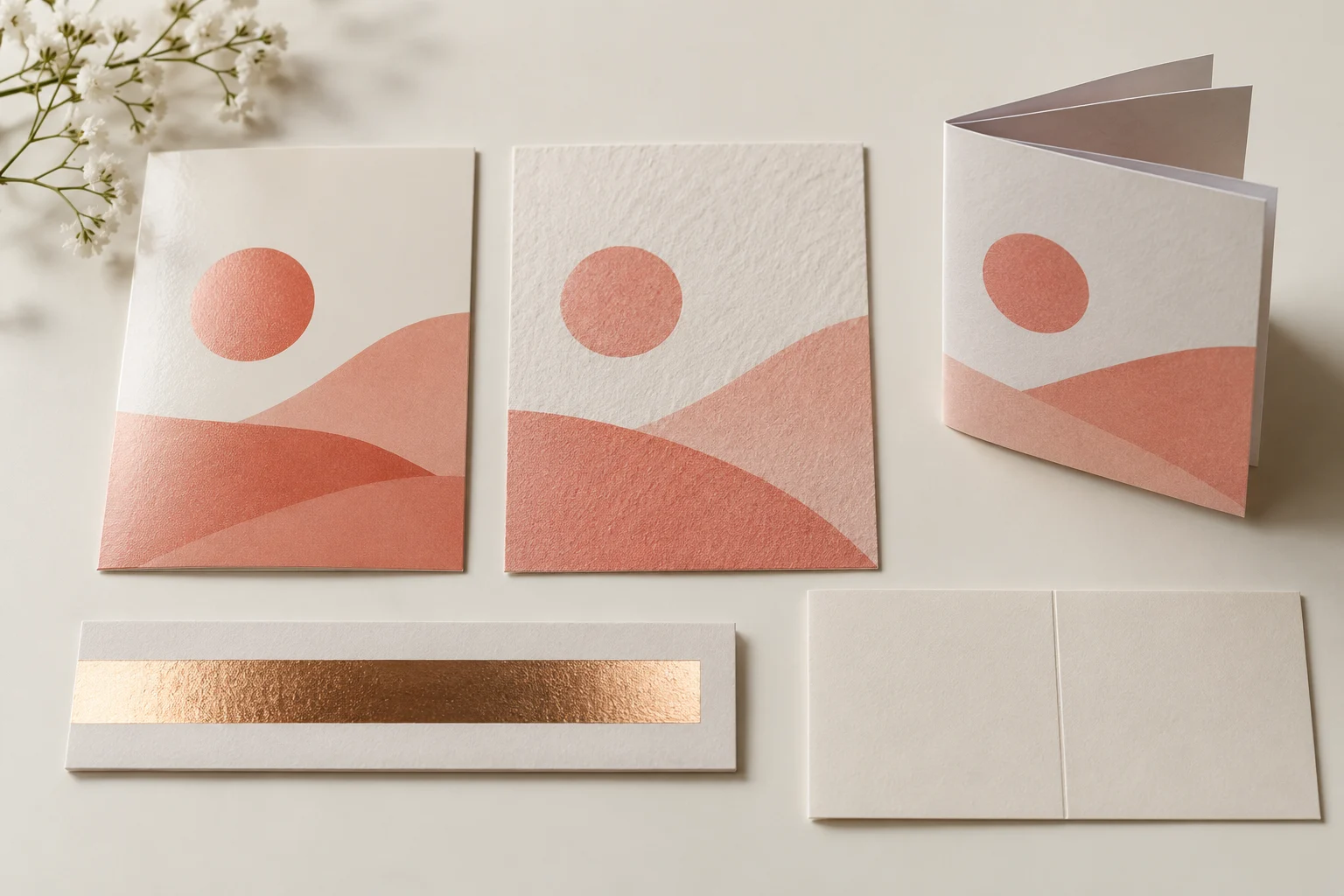
Develop Folded Route, an eight-page A5 walking-guide booklet with a separate production note. Compare two physical stocks, assemble a numbered dummy, test the fold and show-through, and specify one optional foil detail on the cover. Deliver reading-order pages, a fold/binding plan, a finishing-layer requirement and an approval matrix naming what each proof can establish.

  • Plan: Record stock identity, GSM, caliper and grain where relevant.
  • Collect evidence: Document the stock weight and thickness separately, the correct page order, a critical fold or gutter risk, the supplier's finishing convention and the remaining proof limitations.
  • Test: Treating GSM as paper thickness.
  • Revise: change one variable, compare the versions, and keep the stronger evidence.

Takeaway: Record stock identity, GSM, caliper and grain where relevant.
Critique

Diagnose weak decisions

Name the visible problem before proposing a fix. This keeps critique specific and useful.

  • Treating GSM as paper thickness.
  • Guessing a spine width without the chosen paper and page count.
  • Sending imposed sheets when reading-order pages were requested.
  • Using a screen mockup to approve foil, texture or folding.

Takeaway: A strong designer can name the mistake and the fix.

Apply

Use the review rubric

Ask first: Treating GSM as paper thickness.

  • Record stock identity, GSM, caliper and grain where relevant.
  • Verify page count, reading order and binding plan.
  • Test folds, gutters and show-through at actual size.
  • Specify finishing artwork using the supplier's conventions.
  • State exactly which properties each proof approves.

Takeaway: Your design is ready to move forward when you can point to evidence for every criterion.

Apply Paper, Proofing and Finishing

Use the lesson brief below. Fictional project details are practice material, not real event listings.

Develop Folded Route, an eight-page A5 walking-guide booklet with a separate production note. Compare two physical stocks, assemble a numbered dummy, test the fold and show-through, and specify one optional foil detail on the cover. Deliver reading-order pages, a fold/binding plan, a finishing-layer requirement and an approval matrix naming what each proof can establish.

Specification: Use the format named in this lesson’s brief. Collect your comparisons on an A4 landscape sheet (297 × 210 mm) or a digital process board; these are presentation options, not pixel equivalents.

Process

  • List the required content, format, and constraints in the lesson brief.
  • Run the comparison or investigation described in the brief before refining a final response.
  • Record what you changed, measured, or observed.
  • Document the stock weight and thickness separately, the correct page order, a critical fold or gutter risk, the supplier's finishing convention and the remaining proof limitations.
  • Revise a weak decision and save a clear final example or annotated explanation.

Deliverables

  • Document the stock weight and thickness separately, the correct page order, a critical fold or gutter risk, the supplier's finishing convention and the remaining proof limitations.
  • The comparisons, calculations, or project outputs named in this lesson's brief.
  • A short rationale explaining how the lesson's principle informed your decision.
  • A revision or correction, with a note about the evidence that prompted it.
  • A source note for any images, type, and references used, including permissions where relevant.

Review criteria

  • Criterion 1: Record stock identity, GSM, caliper and grain where relevant.
  • Criterion 2: Verify page count, reading order and binding plan.
  • Criterion 3: Test folds, gutters and show-through at actual size.
  • Criterion 4: Specify finishing artwork using the supplier's conventions.
  • Criterion 5: State exactly which properties each proof approves.

Portfolio transfer

Present a small booklet as an approved material and finishing specification, with a physical dummy and proof plan.

Knowledge check

Which check needs a physical sample rather than only a flat screen preview?

  • Whether the selected stock folds, handles and shows through as intended.
  • Whether the PDF contains the intended event date.
  • Whether the exported page count is eight.
  • Whether a spot channel has the agreed name.

Two available stocks both weigh 170 GSM. Can you assume the booklet will have the same spine thickness on either?

  • No; check caliper, page count and the supplier's binding calculation.
  • Yes; GSM and sheet thickness are the same measurement.
  • Yes; a screen mockup determines the final spine.