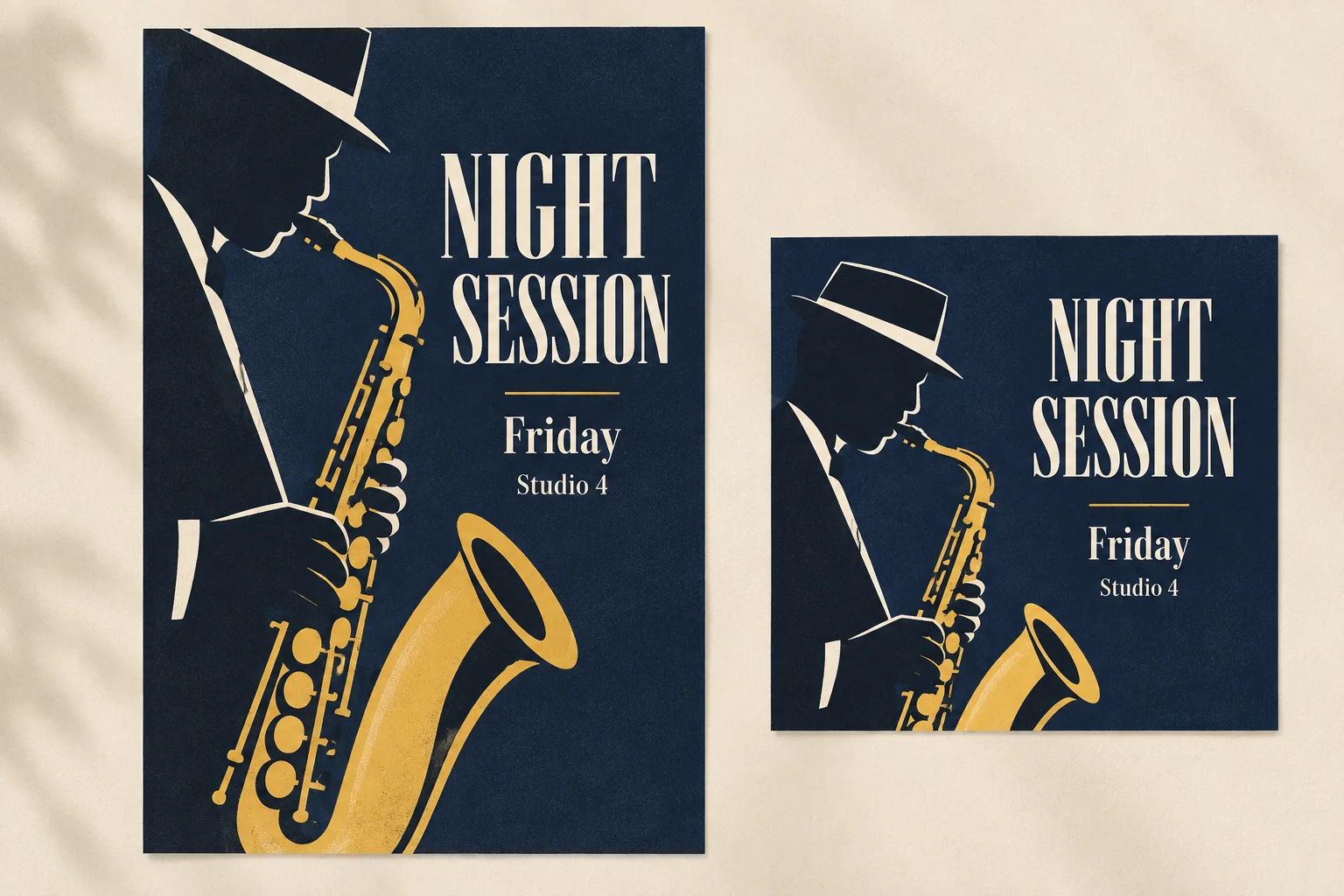
An event poster combines message, hierarchy, image, color, type, spacing, and production choices in one practical format.
Lesson objective and evidence
Make and explain one design decision that demonstrates this principle: An event poster combines message, hierarchy, image, color, type, spacing, and production choices in one practical format.
Prerequisite: Flyer And Poster Basics
Evidence to produce: Confirm every required detail from the brief.
Estimated workload: 5-10 hr project
Beginner Project: Event Poster lesson
Observe
See the communication problem
The brief is a local film night for students, with title, date, location, ticket price, and QR action required.
- What to notice
A poster that looks interesting but hides date, place, or action is not finished.
- Why it matters
A complete project reveals whether individual principles are actually working together.
Takeaway: An event poster combines message, hierarchy, image, color, type, spacing, and production choices in one practical format.
Understand
Understand the principle
An event poster combines message, hierarchy, image, color, type, spacing, and production choices in one practical format.
Use a complete fictional brief so you can judge the result. For this project: Night Session, 7 July, 20:00–22:00, Jazz Hall, free entry, details at example.com/night-session. The audience is local adults curious about live jazz. The tone should feel welcoming and energetic. These are exercise facts, not a real event listing.
Develop three genuinely different structures, then choose using clarity, tone, and adaptability. Resolve an A3 portrait poster and a 1080 × 1350 px digital version. Recompose the digital version rather than shrinking the print sheet, and check every event fact after export. Document imagery and font sources alongside your work.
- Required content
- Information that must survive every layout and adaptation.
- Adaptation
- A composition revised for a different format or context.
Takeaway: A beginner project proves that separate design principles can work together in one deliverable.
Understand
Study the visual model
Takeaway: Use the model as a diagnostic, not a decoration recipe: A poster that looks interesting but hides date, place, or action is not finished.
Try
Follow a worked decision
An illustrative scenario: the proposed result is a hypothesis to check with the intended audience.
- Situation
The brief is a local film night for students, with title, date, location, ticket price, and QR action required.
- Designer move
Choose a cinematic image crop, create a bold title hierarchy, and group logistics in one consistent block.
- Expected result
The final poster feels designed, but the event information remains clear.
Takeaway: Project work is where individual principles become one communication system.
Try
Run the studio method
Design the Night Session brief above. Deliver three thumbnails, an A3 portrait poster, and a 1080 × 1350 px post. Keep all six event facts in both final versions.
- Plan: Move from brief to thumbnails to rough layout to final export.
- Collect evidence: Use a content checklist and document one observed reading problem and the revision that addresses it.
- Test: A poster that looks interesting but hides date, place, or action is not finished.
- Revise: change one variable, compare the versions, and keep the stronger evidence.
Takeaway: Move from brief to thumbnails to rough layout to final export.
Critique
Diagnose weak decisions
Name the visible problem before proposing a fix. This keeps critique specific and useful.
- Designing before writing the event requirements.
- Letting the image overpower the date and place.
- Forgetting to adapt the poster for social use.
Takeaway: A strong designer can name the mistake and the fix.
Apply
Use the review rubric
Ask first: A poster that looks interesting but hides date, place, or action is not finished.
- Confirm every required detail from the brief.
- Create multiple thumbnails before building the final.
- Export both the main poster and a social crop.
- Review the final at small size and from a distance.
Takeaway: Your design is ready to move forward when you can point to evidence for every criterion.
Beginner Project: Event Poster
Use the lesson brief below. Fictional project details are practice material, not real event listings.
Design the Night Session brief above. Deliver three thumbnails, an A3 portrait poster, and a 1080 × 1350 px post. Keep all six event facts in both final versions.
Specification: Document every final format, dimension, color mode, file type, and source asset in the submission.
Process
- List the required content, format, and constraints in the lesson brief.
- Run the comparison or investigation described in the brief before refining a final response.
- Record what you changed, measured, or observed.
- Use a content checklist and document one observed reading problem and the revision that addresses it.
- Revise a weak decision and save a clear final example or annotated explanation.
Deliverables
- Use a content checklist and document one observed reading problem and the revision that addresses it.
- The comparisons, calculations, or project outputs named in this lesson's brief.
- A short rationale explaining how the lesson's principle informed your decision.
- A revision or correction, with a note about the evidence that prompted it.
- A source note for any images, type, and references used, including permissions where relevant.
Review criteria
- Criterion 1: Confirm every required detail from the brief.
- Criterion 2: Create multiple thumbnails before building the final.
- Criterion 3: Export both the main poster and a social crop.
- Criterion 4: Review the final at small size and from a distance.
Portfolio transfer
Export one poster and one social crop from the same event system.